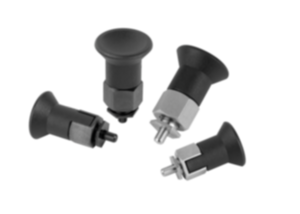
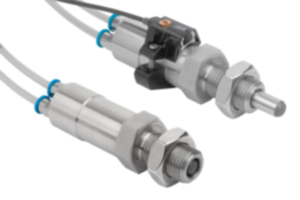
Indexing plunger with status sensor, hardwired steel hardened 03090-20-22061
- vérification électronique de l'état
- distance de commutation courte
Unité de vente
97,79 €
hors TVA
Ajouté à votre panier
Désignation
Doigt d'indexage
Modèle 1
avec capteur d'état, filaire
Modèle 2
PNP contact à fermeture
Forme
B
Type de forme
sans encoche d’arrêt avec contre-écrou
Type de produit
standard
Matériau
du corps de base
acier
Surface
du corps de base
traitée
Matériau
des composants
thermoplastique
Coloris
des composants
gris foncé RAL 7021
D1=Filetage
M12x1,5
D=diamètre de boulon
6
L=Longueur
56
P=longueur de câble
2000
Contre-écrou
avec contre-écrou
Course
S
6
D2
25
D3
2,4
F x 30°
1,8
Force du
ressort finale
F2 env. N
14
Force du
ressort initiale
F1 env. N
6
L1
20
L2
8
L3
17
SW1
14
SW2
19
Taille
2
Type de raccordement
câble en PVC
~ CONFLICT MINERALS 3TG status
3TG possibly contained
~ CONFLICT MINERALS procurement
DRC conflict-free
~ CP65 substance 1 cancer & reproductive toxicity
lead and lead compounds
~ CP65 substance 2 cancer
carbon-black extracts
~ PFAS free?
not yet identified
~ REACH SVHC-free?
yes
~ REACh SVHC 2 name > threshold
previous lead possible
~ RoHS conformity
yes, without exemption
~ TSCA 6(H) conformity
not yet identified
Description
Product description
Indexing plungers are used where any change in locking position due to lateral forces should be prevented. A new indexed position can be only be moved to after the pin has been manually retracted.
Form C and D are recommended for applications where the indexing pin should remain disengaged for an extended period and be prevented from springing back.
With indexing plungers with status sensor, the actuation status can be detected and evaluated electronically.
Form C and D are recommended for applications where the indexing pin should remain disengaged for an extended period and be prevented from springing back.
With indexing plungers with status sensor, the actuation status can be detected and evaluated electronically.
Material
Steel version:
threaded sleeve and indexing pin, free-cutting steel.
Stainless steel version:
Threaded sleeve 1.4305.
Locking pin hardened 1.4034.
Locking pin not hardened 1.4305.
Mushroom grip. thermoplastic.
Version
Steel version:
Threaded sleeve black oxidised.
Indexing pin hardened, ground and black oxidised.
Stainless steel version:
Threaded sleeve bright.
Indexing pin hardened and ground, bright.
Indexing pin not hardened and ground, bright.
Mushroom grip thermoplastic black grey RAL7021.
Threaded sleeve black oxidised.
Indexing pin hardened, ground and black oxidised.
Stainless steel version:
Threaded sleeve bright.
Indexing pin hardened and ground, bright.
Indexing pin not hardened and ground, bright.
Mushroom grip thermoplastic black grey RAL7021.
Note
The status sensor switches when it engages after S - 1 mm travel.
Technical Data
Inductive sensor:
Output circuit: PNP NO
Operating voltage: 6 - 30 V DC
Operating current: <100 mA
Contact gap: 1 mm
Switch frequency: <4000 Hz
Short-circuit proof: yes
Reverse polarity protection: yes
Rating: IP 67
Connection type: 2 m PVC cable
Temperature range: -10 °C - +70 °C
Approvals: CE, c UL us, EAC
Output circuit: PNP NO
Operating voltage: 6 - 30 V DC
Operating current: <100 mA
Contact gap: 1 mm
Switch frequency: <4000 Hz
Short-circuit proof: yes
Reverse polarity protection: yes
Rating: IP 67
Connection type: 2 m PVC cable
Temperature range: -10 °C - +70 °C
Approvals: CE, c UL us, EAC
Application
Indexing plungers with status sensor allow actuation-dependent process control. It is also possible to ensure that the indexing pin is in the desired actuation status.
On request
Special versions.
Drawing reference
Form A: non-lockout type, without locknut
Form B: non-lockout type, with locknut
Form C: lockout type, without locknut
Form D: lockout type, with locknut
P = cable length
BN = brown
BK = black
BU = blue
Form B: non-lockout type, with locknut
Form C: lockout type, without locknut
Form D: lockout type, with locknut
P = cable length
BN = brown
BK = black
BU = blue
Remarque importante concernant le téléchargement des modèles CAO
Pour pouvoir télécharger nos modèles CAO, vous devez d’abord connecter. Si vous n’avez pas encore créé de compte, inscrivez-vous en cliquant sur « Mon compte » (à droite de l’écran) et suivez les instructions.
Other customers also bought